 Fagradalsfjall Volcano Trips
Can You Still See Lava at Fagradalsfjall? What You Will Actually See
Can you still see lava at Fagradalsfjall? No. The honest answer is that nothing has flowed there since the 2023 eruption at Litli-Hrútur, and the Icelandic Met Office confirms there is no active eruption on the Reykjanes peninsula at all. What you will find instead is a young lava landscape from three eruptions between 2021 and 2023: hardened black flows, the craters and a view toward the Sundhnúkur crater row where the last nine eruptions happened. This page lays out exactly what each eruption site looks like today, the full timeline since 2021, and which tours describe it honestly. If you want the wider picture of cost and choice, start with the Fagradalsfjall tours compared by time at the volcano.
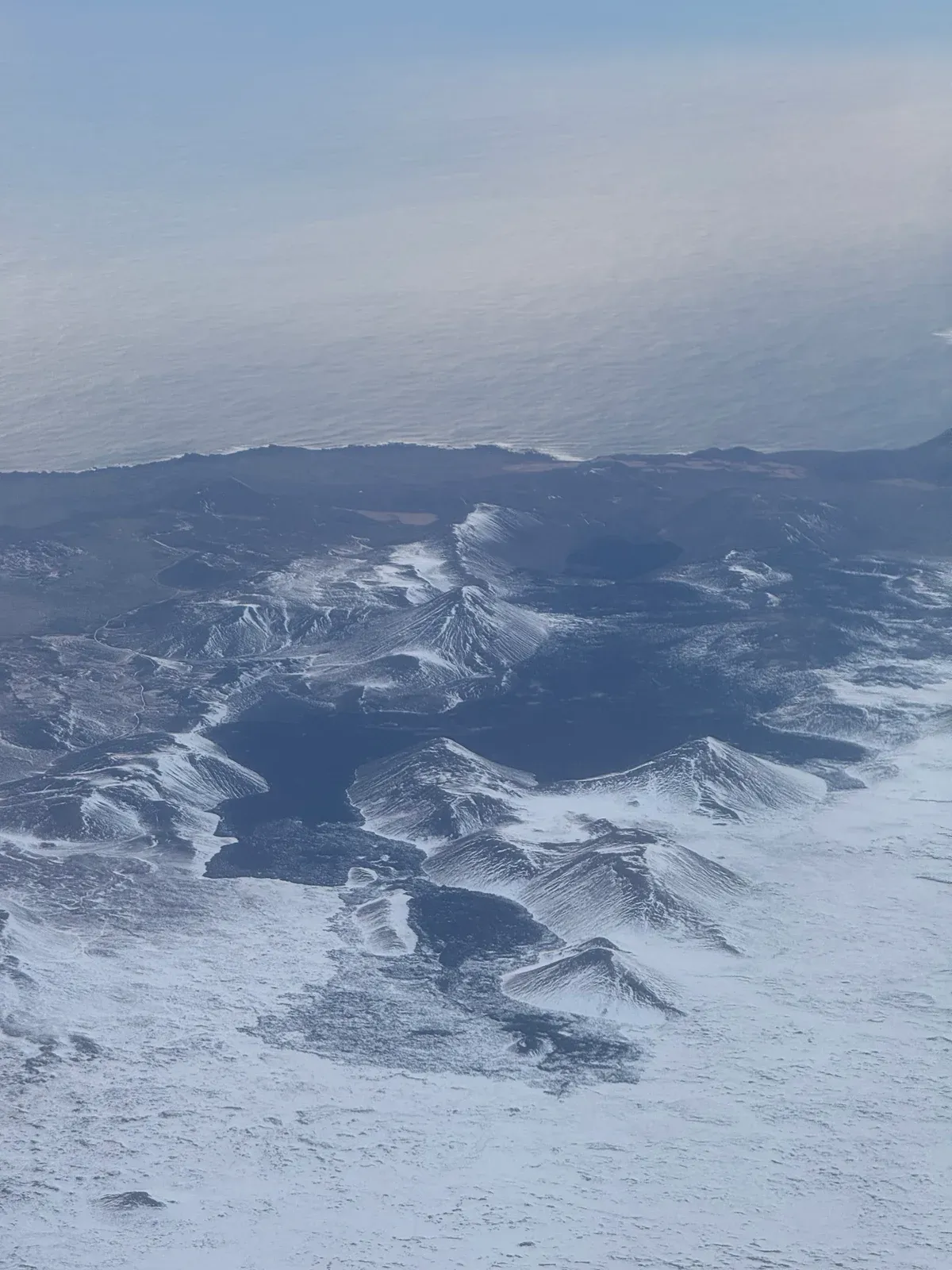
The black lava fields from four years of eruptions now cover several square kilometres around the old hiking trail. Photo: Gaggi96, CC0, via Wikimedia Commons
Quick answer The short answer on lava
No, you cannot see flowing lava at Fagradalsfjall. The Met Office confirms no eruption is active and the ninth and most recent one on the Sundhnúkur crater row ended in early August 2025. What you see instead is cooled lava from the 2021, 2022 and 2023 eruptions, and magma is building again under Svartsengi, so a new event is the likely next step without any predictable date.
Key takeaways
- See the cooled craters up close on the geologist-led crater viewpoint hike at $159.
- Get the whole eruption story from above on the helicopter flight over the eruption sites at $514.
- Check the full status picture in our Fagradalsfjall safety guide.
- Compare every option in the Fagradalsfjall volcano tour prices compared overview.
The Honest Answer: No Lava Is Flowing
The single most important fact about a visit today is that the volcano is quiet. Here is what the authorities actually say.
What the Icelandic Met Office says
The Icelandic Meteorological Office publishes situation updates for the Reykjanes peninsula, and its latest one states plainly that no eruption is active. The most recent event, the ninth in the Sundhnúkur series, ended in early August 2025 after running from 16 July to 5 August 2025. That is the closest thing to an official answer to the question can you still see lava at Fagradalsfjall: no, and the same holds for the whole peninsula.
One caution about other websites. Visit Reykjanes's own eruption FAQ still carries a leftover sentence saying there is an ongoing eruption, next to a newer item on the same site saying there is not. That is stale copy, and the Met Office is the authoritative source here. Any operator page or photo promising flowing lava at Fagradalsfjall is also older than the current situation, because nothing has erupted there since 2023.
The magma is still building under Svartsengi
Quiet does not mean finished. According to the Met Office, roughly 29.1 million cubic metres of magma accumulated under Svartsengi between 17 July 2025 and 16 August 2026, with an uncertainty range of 28.3 to 29.9 million cubic metres. Over the three months before the latest update the land rose by about five centimetres at the SKSH GPS station. Seismicity along the Sundhnúkur crater row and near Grindavík remains low, though there has been a slight recent increase in small earthquakes, including within the magma intrusion.
The Met Office's own wording on the next step is clear: as long as uplift continues, the most likely scenario is a magma intrusion propagating from Svartsengi into the Sundhnúkur crater row, which could lead to an eruption. It is not possible to predict when, and a short lead time must be expected. An eruption can close trails, roads and Grindavík at short notice rather than open a viewing opportunity, so book flexible dates. The Fagradalsfjall safety guide covers what happens if the ground wakes up mid-trip.
Where the eruptions moved after Fagradalsfjall
Fagradalsfjall itself erupted three times, then the activity shifted. In December 2023 the Sundhnúkur crater row series began a few kilometres north of Grindavík and northeast of Fagradalsfjall, and it produced nine eruptions through August 2025. That means the newest, rawest lava on the peninsula is not at Fagradalsfjall at all.
The Sundhnúksgígar site near Grindavík is closed, with no hiking trails or parking areas currently defined there. From the Fagradalsfjall trail network you can see toward the crater row, which is the closest most visitors get to it today.
The Three Fagradalsfjall Eruptions and What Each Site Looks Like
Three eruptions shaped the Fagradalsfjall area between 2021 and 2023. Each left a different landscape you can walk to.
Geldingadalir and the 2021 eruption
The first eruption began on 19 March 2021 and ran 181 days, until 18 September 2021, making it the longest eruption of the 21st century in Iceland. It was the first on Fagradalsfjall in about 6,000 years and the first anywhere on the Reykjanes peninsula since the medieval Reykjanes Fires ended around 1240. It produced 151 million cubic metres of lava covering 4.8 square kilometres by mid-September 2021.
Today Geldingadalir gives its name to parking P1, and Path A, about 6-8 km one way, passes the 2021, 2022 and 2023 eruption sites. At P1 (Geldingadalir) and parking costs 1,000 ISK (about $8) per vehicle for a 24-hour ticket paid through the Parka app or parka.is.
Meradalir and the 2022 eruption
The second eruption lasted less than three weeks, from 3 to 21 August 2022, and poured about 12 million cubic metres of lava over the 2021 flows in the Meradalir valley. Meradalir sits behind the first lava field, so reaching it is a longer walk. Path E to Meradalir runs about 18-20 km both ways, 5-6 hours of hiking before any viewing stop.
This is the site the Meradalir hike and northern lights combo targets, a long day priced at $185 that pairs the hike with an evening aurora drive.
Litli-Hrútur and the 2023 eruption
The third and final Fagradalsfjall eruption ran from 10 July to 5 August 2023 at Litli-Hrútur, producing about 15.9 million cubic metres of lava over roughly 1.5 square kilometres. It started significantly stronger than the first two. The Litli-Hrútur site is the youngest of the three.
Tours such as the afternoon hike to the new volcano site at $132 walk toward this area. If you want to know how the whole thing feels before you commit, the worth-it guide weighs the cooled landscape against other uses of a day.
Can You Still See Lava At Fagradalsfjall on Video
A thermal drone pass over the newest craters, finding them cold. Third-party video by Iceland Explorer. We did not shoot it and have no relationship with the creator.
The Full Eruption Timeline Since 2021
Twelve eruptions have hit the Reykjanes peninsula since 2021: three at Fagradalsfjall and nine on the Sundhnúkur crater row. The table below puts every one in order with its dates, length and lava volume, drawn from the Icelandic Met Office announcements and the published eruption records. It is the fastest way to see why the landscape you will walk on is stacked in layers.
Every eruption in order
Read the table from top to bottom. The first three rows built the Fagradalsfjall trail network you can still hike. The remaining nine happened near Grindavík, at a site that is currently closed to visitors.
| # | Site | Dates | Length | Lava volume |
|---|---|---|---|---|
| 1 | Fagradalsfjall, Geldingadalir | 19 Mar to 18 Sep 2021 | 181 days | 151 million m³, 4.8 km² |
| 2 | Fagradalsfjall, Meradalir | 3 to 21 Aug 2022 | 18 days | 12 million m³ |
| 3 | Fagradalsfjall, Litli-Hrútur | 10 Jul to 5 Aug 2023 | 26 days | 15.9 million m³, 1.5 km² |
| 4 | Sundhnúkur, near Hagafell | 18 to 21 Dec 2023 | 3 days | 12 million m³ |
| 5 | Sundhnúkur, north of Grindavík | 14 to 16 Jan 2024 | 2 days | 2 million m³ |
| 6 | Sundhnúkur, north of Sýlingarfell | 8 to 10 Feb 2024 | 1.5 days | 13 million m³ |
| 7 | Sundhnúkur, Hagafell-Stóra-Skógfell | 16 Mar to 9 May 2024 | 54 days | 35 million m³ |
| 8 | Sundhnúkur, near Sundhnúksgígar | 29 May to 22 Jun 2024 | 24 days | 45 million m³ |
| 9 | Sundhnúkur, Sundhnúksgígar chain | 22 Aug to 6 Sep 2024 | 14 days | 61 million m³ |
| 10 | Sundhnúkur, Sundhnúksgígar area | 20 Nov to 8 Dec 2024 | 18 days | 47 million m³ |
| 11 | Sundhnúkur, Litla-Skógfell | 1 Apr 2025 | about 7 hours | minimal output |
| 12 | Sundhnúkur, Sundhnúksgígar | 16 Jul to 5 Aug 2025 | about 20 days | Not published |
What the timeline means for your visit
Two things follow from those numbers. First, the Fagradalsfjall trail network covers eruptions one to three, so it is permitted for hiking whenever no eruption is active, which is the situation now. Second, the most recent lava of the whole series lies at the Sundhnúkur crater row, and that site is closed with no defined trails or parking.
The 61 million cubic metres from the sixth Sundhnúkur eruption alone were more than five times the whole 2022 Meradalir event, but you see it from a distance or from the air rather than up close. The helicopter flight over Litli-Hrútur, Geldingadalir and Fagradalsfjall also crosses toward Grindavík on its route, which is the easiest way to grasp the scale of the newer flows.
Sources: Icelandic Met Office news, 2023-2025 Sundhnúkur eruption records
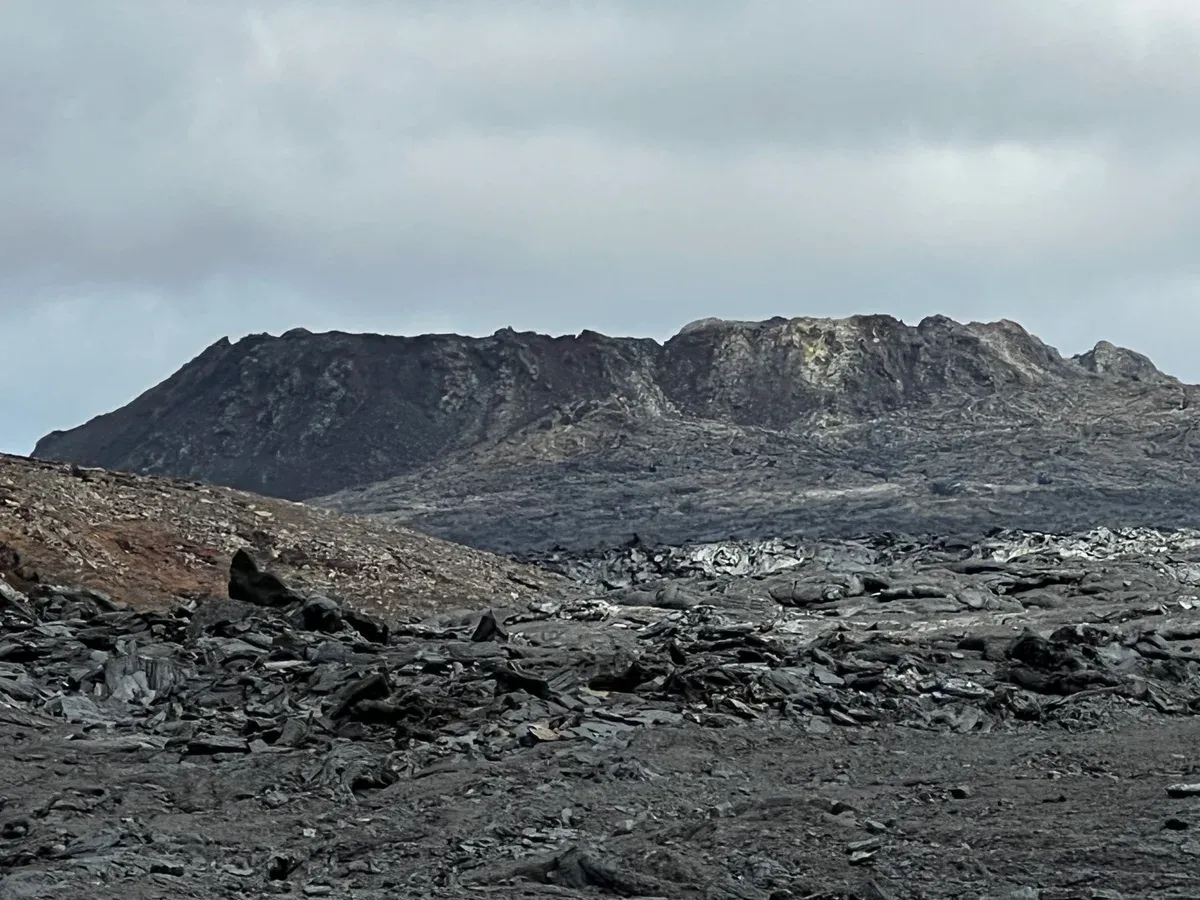
The Geldingadalir crater has been cold and silent since its 2021 vent shut down. Photo: Stefan mohanu, CC BY-SA 4.0, via Wikimedia Commons
What You Actually See on the Ground
With no eruption running, the sights are geological rather than fiery. Here is what fills a visit in practice.
Cooled Lava and the Craters
The core sight is the lava itself, solid and cooled. Path A passes the 2021, 2022 and 2023 eruption sites over about 6-8 km one way. Path C over Langihryggur, about 4 km one way, looks across all three eruptions but cannot see the crater itself.
The 2021 flow alone covers 4.8 square kilometres and the 2023 flow about 1.5 square kilometres. Walking on the lava is strictly forbidden even now, since the crust can be thin over hot rock underneath.
The view toward the Sundhnúkur crater row
From the higher ground around Fagradalsfjall you can look northeast toward the Sundhnúkur crater row near Grindavík, the scene of all nine eruptions from December 2023 to August 2025. You are looking at the peninsula's newest lava from outside it, because no trails or parking are defined at the closed Sundhnúksgígar site. Several tours build this into the day.
The Reykjanes minibus circuit from Arctic Adventures at $113 stops at the Nátthagi viewpoint above Fagradalsfjall for about an hour and then drives through Grindavík and past the Sundhnúkagígar and Svartsengi lava field. The Grindavík and Krýsuvík circuit from Click Tours at $186 follows a near-identical route.
From the air
A flight changes the picture completely. The 40-minute GlacierHeli trip at $514 passes over Litli-Hrútur, Geldingadalir and Fagradalsfjall, with about 20 minutes of the flight over the volcano area, and it is upfront that visible lava cannot be guaranteed. Some travelers report an unadvertised landing on the lava field, but the listing does not promise one, and the flight needs a minimum of 4 passengers or it is cancelled with a full refund.
If the aerial idea appeals mainly for pictures, our photo spots guide covers the ground-level angles too. To plan the walking part yourself instead of booking, the without-a-tour guide lists every marked path.
Which Listings Describe the Site Honestly
Operator listings lag reality by years, and a few still sell the 2023 eruption as if it were happening. Here is how the main options frame the truth.
Listings stuck in 2023
At least one tour description on the market still advertises erupting lava at Litli-Hrútur, a flow that stopped in August 2023. Within the listings compared here, the afternoon hike to the new volcano site at $132 and the eruption site hike and Reykjanes tour at $134 both carry an old note saying the lava at Litli-Hrútur has only just stopped and the area is still smoldering, written for 2023 with no year attached. The hike and northern lights combo at $185 goes further and calls the destination a live volcanic eruption with magma erupting from the core, which does not match reality at all.
Re-read any description before you pay, and treat flowing-lava photos as pictures of the past.
Listings that tell the truth
Several operators frame it correctly. The volcanoes, Grindavík and hot springs tour at $122 states plainly that no lava is currently flowing and that its route only turns into an eruption-viewpoint stop if a new eruption starts and conditions allow. The crater viewpoint hike with a geologist at $159 gives you a volcanologist to explain the cooled landscape, capped at 6 travelers, though it is rated difficult over rough terrain and excludes children under 12.
The small-group original local volcano hike at $157 notes in its own listing that visible lava can never be guaranteed and that its photos come from past tours, which is exactly the honesty to look for. Prices above are the listed per-person rates from the Fagradalsfjall tour price comparison.
Do and Don't on a Lava-Free Volcano
A quiet volcano has its own rules. These are the ones that decide whether the day works.
Do
- Do book a guide or a geologist if the geology is the point, because cooled lava explains itself far better with someone who reads it, like the $159 geologist hike.
- Do check the live gas forecast at loftgaedi.is before and during the walk, because gas pollution is odourless, invisible and can collect quickly at the site.
- Do expect to see the Sundhnúkur crater row only from a distance, because the Sundhnúksgígar site is closed with no trails or parking defined.
- Do check road.is or umferdin.is and safetravel.is before you drive, because route access changes with volcanic activity.
Don't
- Don't walk on the lava under any circumstances, because even after an eruption ends the crust may be thin over hot rock, and hiking on it stays strictly forbidden.
- Don't book any listing that promises flowing or erupting lava at Fagradalsfjall, because nothing has erupted there since August 2023 and the whole peninsula has been quiet since August 2025.
- Don't treat a new eruption as a guaranteed future show, because the Met Office says a next event is likely but cannot be predicted, and it would close trails and roads rather than reliably open a viewing.
What You Will See Questions
Is there still lava at Fagradalsfjall?
No. Nothing is erupting at Fagradalsfjall, and the most recent eruption there was at Litli-Hrútur from 10 July to 5 August 2023. You see cooled lava fields instead, and the Icelandic Met Office is the source for the current status in our status and safety guide.
When was the most recent eruption of Fagradalsfjall?
The most recent Fagradalsfjall eruption was the Litli-Hrútur event of 2023. The most recent eruption on the peninsula as a whole was the ninth Sundhnúkur eruption, which ran from 16 July to 5 August 2025. The full sequence is laid out in the eruption timeline above.
Can you see active lava in Iceland right now?
Not on the Reykjanes peninsula. The Met Office confirms no active eruption anywhere in the series, so there is no flowing lava to watch at Fagradalsfjall or near Grindavík today. If you want the closest honest substitute, the helicopter flight over the eruption sites shows the 2021-2023 eruption sites from the air.
Where is the best place to see lava in Iceland?
With nothing erupting, nobody can point to flowing lava on the Reykjanes peninsula today. The best accessible young lava is the 2021 to 2023 Fagradalsfjall field, reached on foot from the P1 and P2 car parks as described in the without-a-tour guide. The even younger Sundhnúkur flows near Grindavík are closed to hiking.
How far do you walk to see the eruption sites?
Path A runs about 6-8 km one way and passes the 2021, 2022 and 2023 eruption sites. Path C over Langihryggur, about 4 km one way, views all three eruptions but not the crater, and the Nátthagi paths are about 2 km one way. The geologist-led crater viewpoint hike takes about 1 to 1.5 hours each way to its viewpoint.
What happens if a new eruption starts while I am there?
The Met Office names a new magma intrusion or eruption as the most likely next step, but nobody can predict a date and the lead time can be short. An eruption closes trails, roads and Grindavík at short notice rather than guaranteeing a viewing. Cancellation terms and refund rules are covered in the weather cancellations guide.
Can I walk on the lava to get a closer look?
No, and this rule holds even with no eruption running. The crust can still be thin over hot rock underneath, so walking on the lava is strictly forbidden, as Safetravel and Visit Reykjanes both state. The safety guide lists the other ground and gas hazards to know before you go.